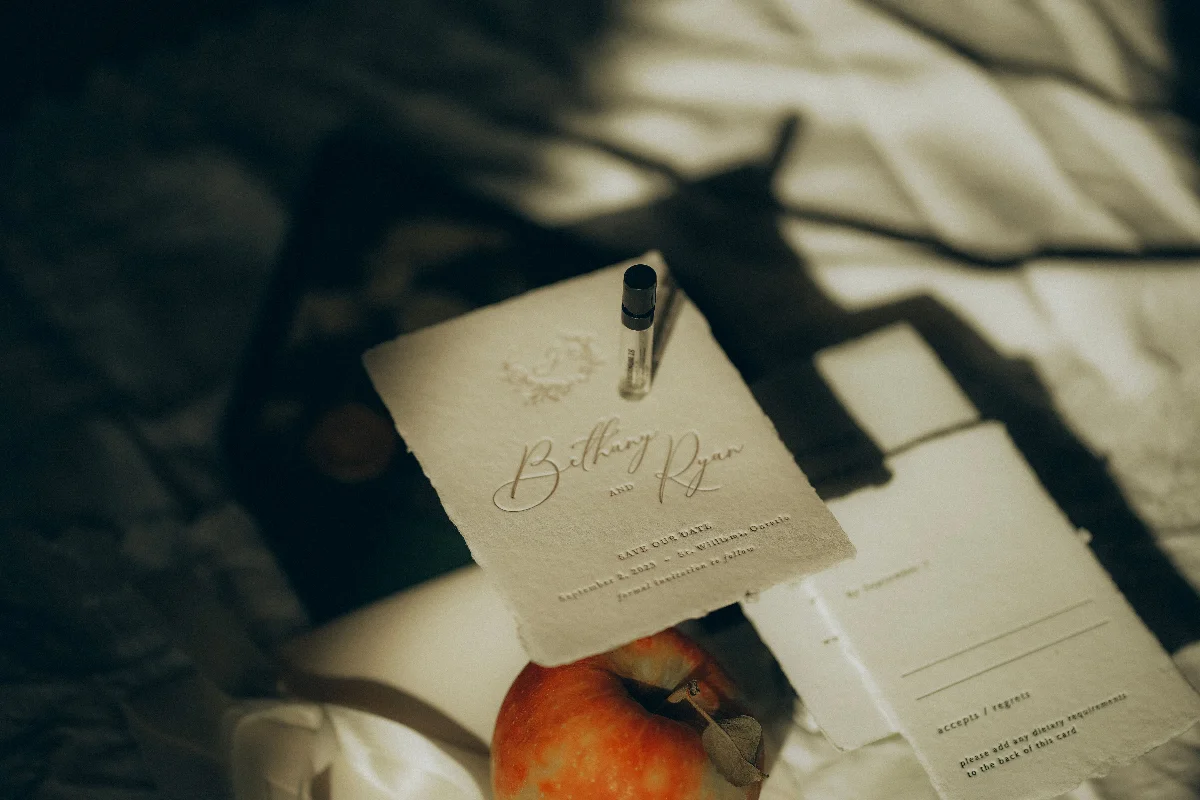
This page is worth reading because it gives you exact wording structures for every formality level and a complete checklist of what your invitation must say, so you never leave out a crucial detail.
The short answer
When writing your invitation wording, start with the host line (who is inviting), then the request line (e.g., "request the honor of your presence"), the couple's names, date and time, location, and reception details. Choose formal language like "the honour of your presence" for a traditional ceremony, or casual phrasing like "join us" for a relaxed event. Always include the full date and time, even if it's implied by the ceremony start. The reception line can be on a separate card if space is tight, but never omit direction for what guests do after the ceremony.
The decisions this settles
This page is worth reading because it gives you exact wording structures for every formality level and a complete checklist of what your invitation must say, so you never leave out a crucial detail.
Questions to answer before you commit
- Who is issuing the invitation: the bride's parents, both sets of parents, the couple themselves, or another sponsor?
- How formal is your wedding: black-tie traditional, semi-formal, or casual?
- Do you need to include separate reception card wording or will it fit on the main invitation?
- How will you handle parents who are divorced or remarried: do you list them separately or jointly?
- What is the exact venue name and address you need to include, including potential directions or a map?
What each choice changes
| What to compare | What to ask for | The decision it changes |
|---|---|---|
| Formality Level | Ask your stationer for wording samples for each of these: traditional (e.g., 'request the honour'), semi-formal ('request the pleasure'), and casual ('invite you to celebrate'). | Determines which verb tense, punctuation style (spelled out vs. numerals), and whether to use 'and' versus ampersand. |
| Host Line | Compare how different host lines read: 'Mr. and Mrs. John Smith' vs. 'Together with their families' vs. 'Sarah Smith and James Doe'. | Decides whose names appear first and whether in-laws are mentioned, which sets the tone for family involvement. |
| Date and Time Format | Get written confirmation of the exact date and time strings: 'Saturday, the twelfth of April, two thousand twenty-five' vs. 'April 12, 2025, 3:00 p.m.'. | Affects the invitation's formality and clarity for guests who rely on unambiguous timing. |
| Reception Details Placement | Ask for two versions: one with reception info on the main card, one on a separate card. Compare the wording 'reception immediately following' vs. a separate card with time and location. | Changes the number of enclosures and whether guests must refer to a second card to know where to go. |
| RSVP Method | Compare wording for 'Please reply' vs. 'Kindly respond by' vs. 'RSVP by' and how the deadline is stated (e.g., 'by the first of May' vs. 'by May 1' vs. 'by 05/01/25'). | Determines guest response timing and how you track attendance; also influences whether you include an RSVP card or rely on online responses. |

A worked wedding invitation wording example
Turning a guest list into a mailing count
- 88 households or couples invited together receive one invitation each.
- 6 people need their own mailing: adult children at other addresses, colleagues, single friends invited alone.
- That is 94 invitations to send.
- Add 10 spares for addressing mistakes, keepsakes and late additions.
- Order 104. Note that this is a mailing count, not a guest count.
| Line | Amount |
|---|---|
| Households | 88 |
| Separate mailings | 6 |
| Base invitations | 94 |
| Spares | 10 |
| Order quantity | 104 |
CalculatorWedding Invitation Quantity Calculator

Mistakes to avoid with wedding invitation wording
Each of these is cheap to avoid now and expensive to fix later. They are the mistakes that surface in the final invoice.
Watch for
- Omitting the year from the date, causing guests to wonder if you meant next year or the year after, leading to confusion and cancellations.
- Forgetting to include a deadline for RSVPs, resulting in late or no responses that delay final headcounts and seating.
- Listing parents' names incorrectly on a divorced-couple host line, sparking family disputes that require a costly reprint.
Your next conversation, in checklist form
Your next conversation, in checklist form
- Confirm the host line wording with all parents or sponsors before printing.
- Spell out all numbers in the date and time for formal invitations (e.g., "two thousand twenty-five" not "2025").
- Include a clear reception line even if it's on a separate card; never leave guests guessing.
- Double-check that the ceremony start time matches the venue's actual doors-open and procession timing.
- Add an inner envelope if you are inviting families with children or guests with plus-ones to show exactly who is invited.
- Read the full invitation aloud to catch awkward phrasing or missing punctuation.
Wedding invitation wording: common questions
Should I include registry information on the invitation?
No. Never put registry details or a gift request directly on the invitation, as it can appear demanding. Instead, include a link on your wedding website or mention it by word of mouth.
How do I word the invitation if my fiancé and I are hosting ourselves?
Use a simple host line like "Together with their families" or simply state "The pleasure of your company is requested at the marriage of [Bride] and [Groom]." You can also begin with "You are invited to celebrate the wedding of..."
What if my venue has a long name or address that doesn't fit on one line?
You may abbreviate common directions (St., Ave., NW, etc.) or split the address across two lines. Prioritize including the city and state on the same line if possible to avoid confusion.
Where to go next
Now that your wording is set, explore how to format your reception card, enclosures, and RSVP card wording on the next pages.